
Right Battery for your thruster/trolling motor?
There are many factors to consider when selecting a lead acid battery for your RV’s house applications (fridges, electronics and accessories). It is important to look at battery type, technology, construction and maintenance when assessing your RV house battery needs in order to avoid battery failures, performance problems and to ensure that your battery is reaching its expected life and performance. Not all lead acid batteries are designed and manufactured equally, so we will compare the benefits and features of the available deep cycle battery types and technologies to identify which battery is the ideal solution for your RV 12V house applications.
DEEP CYCLE BATTERIES
For optimal performance and to reduce premature battery failure, it is extremely important to determine your
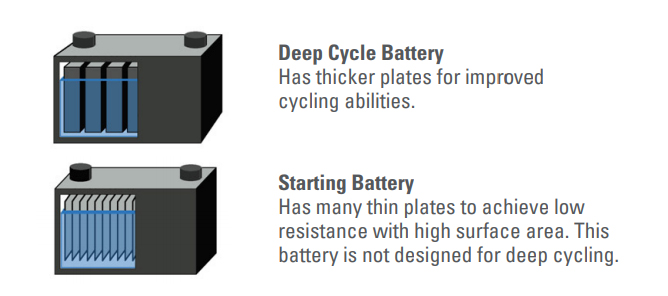
application needs first. To power the house portion of your RV, camper or boat, your house battery must be a true deep cycle battery. This will ensure that there is a steady amount of power being delivered to your applications over a long period of time without interruption or failure, and that the sizing of your battery selection is adequate for the depth of discharge you require. A starting battery will not be able to meet the needs of your 12V house applications and will only be able to provide high power and large starting currents in short bursts. A true deep cycle battery is designed and manufactured to store a large quantity of energy, to discharge deeply and recharge repeatedly. A deep cycle battery is able to achieve greater cycle capacity, and increased life because of its thicker plates compared to starting batteries. As you see, thicker plates and a denser active material ratio provides deeper discharges, greater run times and increased life than a starting battery would.
DEEP CYCLE BATTERY TECHNOLOGIES
To understand the differences between deep cycle batteries, we will look at four different technologies: Flooded Lead Acid, Gel, AGM and Discover Dry Cell EV Traction batteries.
Flooded lead acid batteries contain liquid electrolytes that are completely free-flowing with removable watering fill caps for servicing. Because of their internal chemical reactions and heating during charging, they lose water that must be replaced through regular servicing and maintenance.
Flooded lead acid batteries are considered a hazardous technology as they are spillable and produce off gassing which may result in corrosion and damage to the equipment and environment. Although flooded lead acid batteries have an initial lower cost to purchase, and are widely available, they require the most maintenance in terms of inspection, servicing and storage.
A Gel battery is a sealed valve-regulated lead acid recombinant battery that is non-spillable and maintenance-free. In this battery, the plates are thinner and the electrolyte is mixed with an additive which changes it into a gelled consistency. The issues with Gel batteries are that they require precise charging, slower charging voltage rate and time and can easily be damaged if they are overcharged. When taking charging time, maintenance and performance into consideration, their overall cost of ownership increases.
An AGM battery is also a sealed valve-regulated lead acid recombinant battery that is non-spillable and maintenance free.The difference between an AGM battery and a Gel battery is that it’s electrolyte composition is not a gel substance. The AGM battery electrolytes are absorbed and are trapped in a matted glass fibre separator material. The AGM battery has thinner plates and their grid structure cannot handle being cycled to a depth of discharge greater than 50%. Users will be required to replace batteries more frequently to compensate for their shorter life span and performance.
A Discover Dry Cell EV Traction battery has the thickest plates out of the four batteries we are looking at, along with higher density and active materials, resulting in higher performance, greater capacity and longer life. These batteries are also completely sealed and maintenance-free and designed to eliminate corrosion due to off-gassing, and safeguard against spills and corrosion related issues. Although Discover Dry Cell EV Traction batteries are initially more expensive to purchase, they offer a lower total cost to own over the life of the battery when maintenance, performance, health and safety are taking into consideration. Selected battery chargers with an optimized Discover Dry Cell EV Traction algorithm will maximize the run time and service life performances that they are designed for.